Save the Spring is a partnership between the River Dee Trust, Dee District Salmon Fishery Board and Atlantic Salmon Trust, supported by the University of Stirling and UHI Inverness.
Habitats Reconnected
Works carried out under the Save the Spring programme have complemented wider efforts across the upper catchment by the River Dee team throughout 2025, where reconnecting fragmented habitats has been a key focus. The upper catchment – upstream of Aboyne, is key to spring salmon spawning.
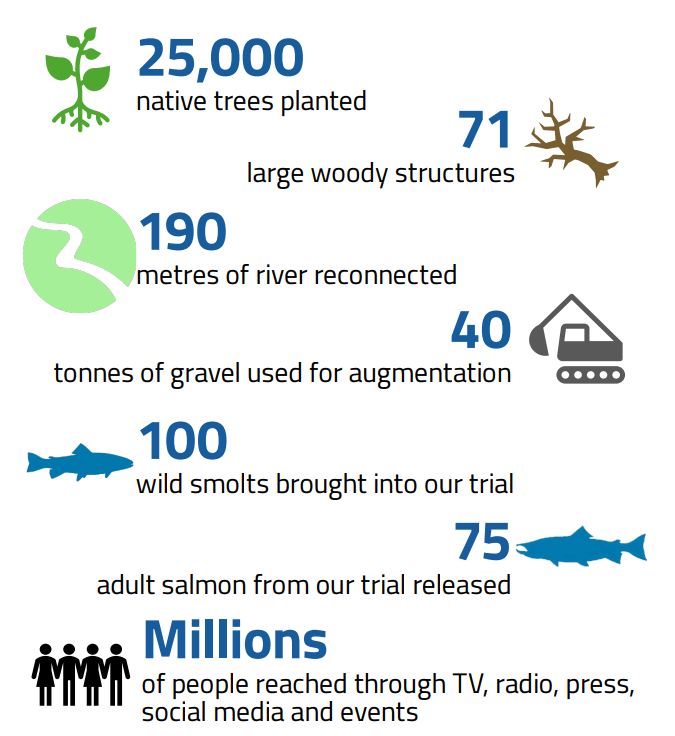
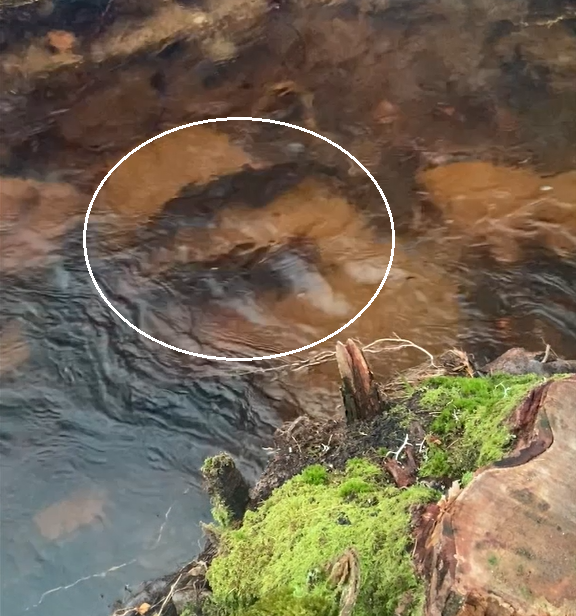
This year, with the ongoing support of the Balmoral Estate, we reconnected a 190m side channel of the River Muick which had been cut off from the main stem of the river by significant erosion and sedimentation during severe winter flood events. This work was completed in September and, by early November just 44 days after the work finished, salmon were seen spawning in the channel. The team was able to visually record six adult salmon and four large redds (salmon nests), indicating successful spawning. This is a hugely positive sign which shows just how important channel reconnection and realignment can be for wild salmon recovery efforts. In addition, juvenile salmon parr and brown trout have been seen using the restored channel as well.
Further restoration work was carried out on another previously reconnected 375m side channel in the River Muick, supported by Glen Muick Estate. Employing local contractors, we added 40 tonnes of gravel to the channel – a technique known as ‘gravel augmentation’ – to provide better habitat for salmon spawning. This material had previously been washed downstream during flood events, forming large deposits which we were able to re-use. Once again, the team was able to witness adult salmon moving into the area and counted three salmon redds, as well as adult salmon, sea trout and juvenile salmon with underwater cameras. The reinstatement of this channel provides salmon with an important mid-river spawning zone as the only other known spawning sites were 3km upstream and 1.3km downstream.
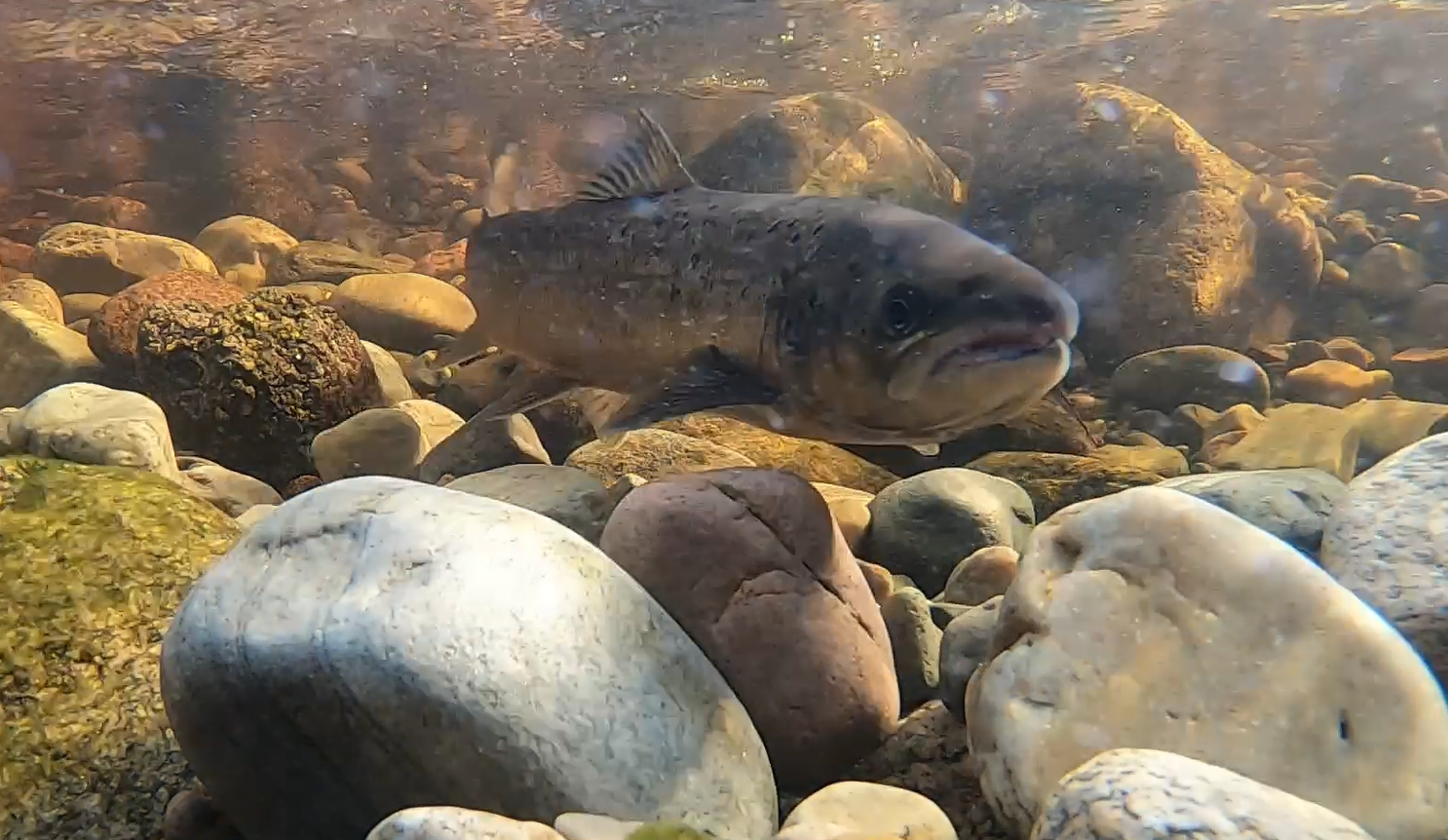
Salmon were filmed spawning in the restored channel just 44 days after work completed.
Along with channel reconnection, other work has been progressing. Over 70 large woody structures in the form of dead trees were installed, principally on the upper River Dee with support from the National Trust for Scotland’s Mar Lodge Estate. We have seen how these structures are helping to add complexity and biodiversity to stream channels elsewhere in the catchment and look forward to monitoring the effects of these interventions over the coming months and years.
The River Dee team also planted a further 25,000 native riverside trees prior to April 2025, with another 3,500 planted this autumn. We’ve entered a new season of this work, during which we’ll continue to build stability, resilience and biodiversity in the catchment to benefit wild salmon and other species.
Looking ahead to 2026, we are set to embark on a significant Mar Floodplain restoration project in the summer.
Two adult salmon filmed spawning in a restored channel, using areas where gravel augmentation work took place.
Smolt-to-Adult Supplementation Trial Milestone
As reported in detail in our October 2025 Update, this year we reached a key milestone in the programme’s smolt-to-adult supplementation trial. Thanks to a huge combined effort, particularly from our colleagues at the University of Stirling, 75 mature adult salmon from the programme were released back into the River Muick in the autumn, ahead of the spawning season. Full details on why this approach is being taken, and how it is practically being carried out, can be found in our last update, including the challenges and unknowns that lie ahead.
Since their release the team has been busy radio tracking to monitor the movements of the 48 radio tagged fish. The ‘heatmap’ below offers a snapshot of their dispersal throughout the Muick, with the yellow hotspots showing where fixed radio monitoring equipment is in place, and therefore able to record more detections than elsewhere. On-foot surveys with handheld equipment have enabled the fish to be located in areas less easy to access.
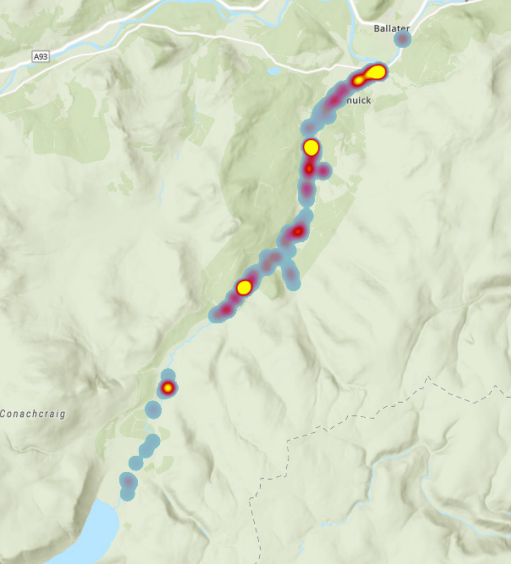
Heatmap showing the initial dispersal of released fish throughout the River Muick.
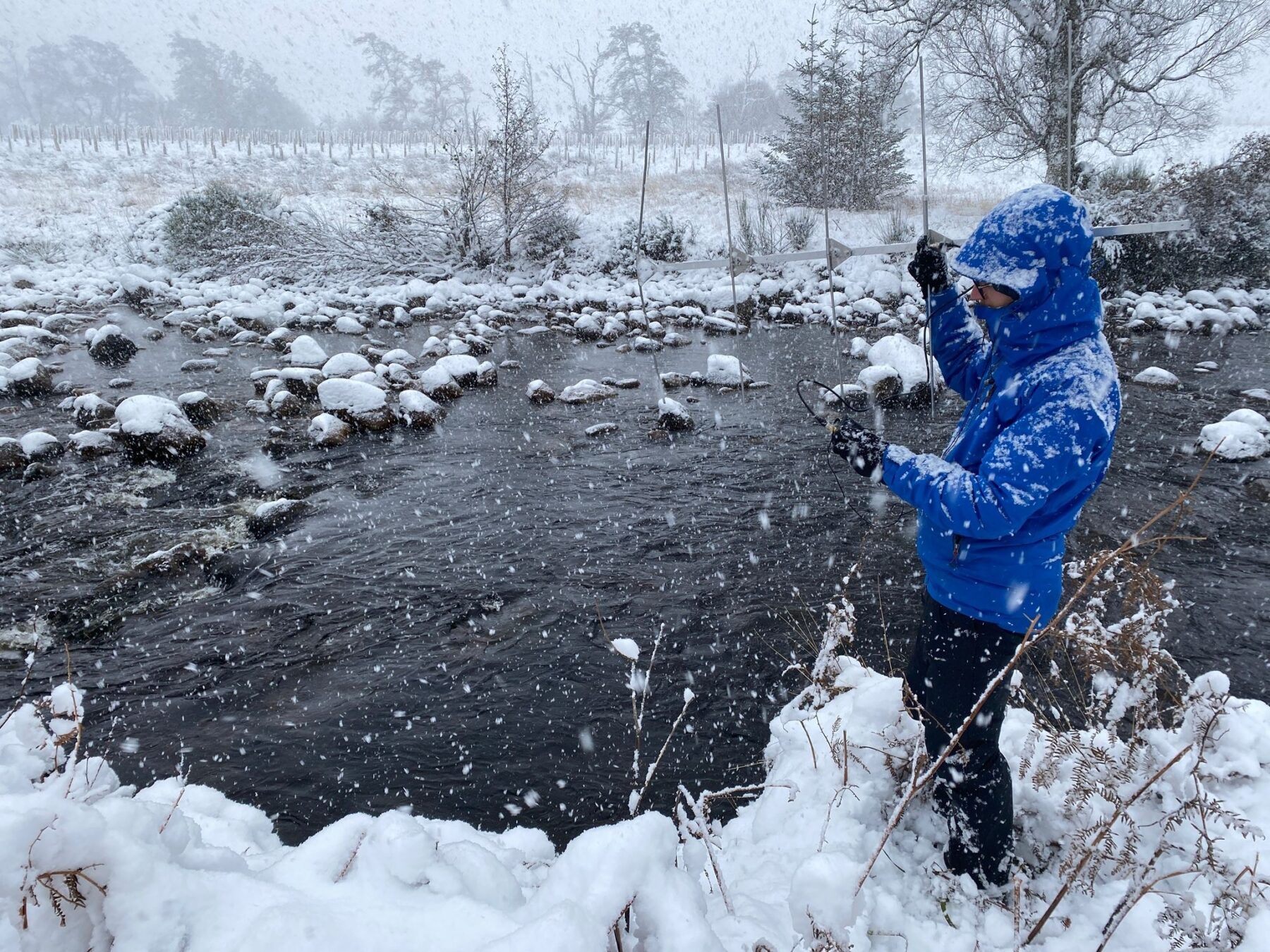
The team has been out in all weathers operating portable radio tracking equipment to monitor the movements of released fish.
Key to measuring the impact of the trial over the long term will be juvenile surveys and genetic monitoring. Genetic samples were taken from every fish which has entered the trial. Through future juvenile survey work and genetic sampling, we will be able to determine the contribution to the population made by fish in the trial, matching juveniles to their parents. With this information, and after conducting the trial for several years, we will be able to understand the viability and impact of this technique.
With a further 100 smolts brought into the programme in 2025, we look forward to sharing the progress of this second cohort of fish next year, along with how the lessons we are learning along the way are enabling us to adapt and improve the trial going forward.
2025 in numbers