
Posted on 2nd Nov 2026
Adult salmon return to the River Muick
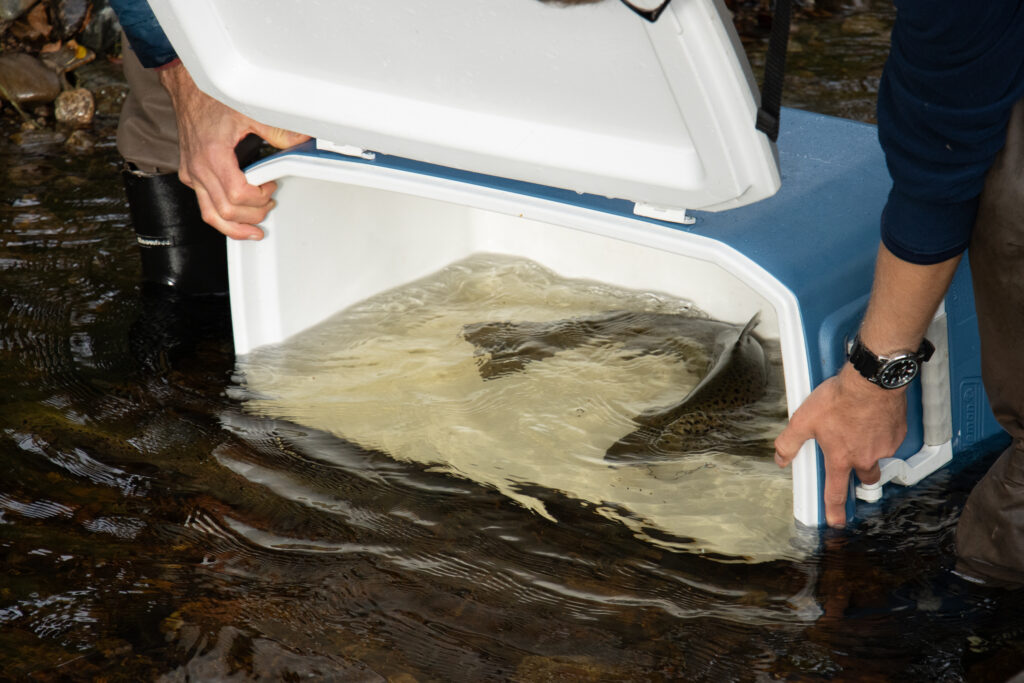
The second cohort begins its spawning journey following release in October 2026
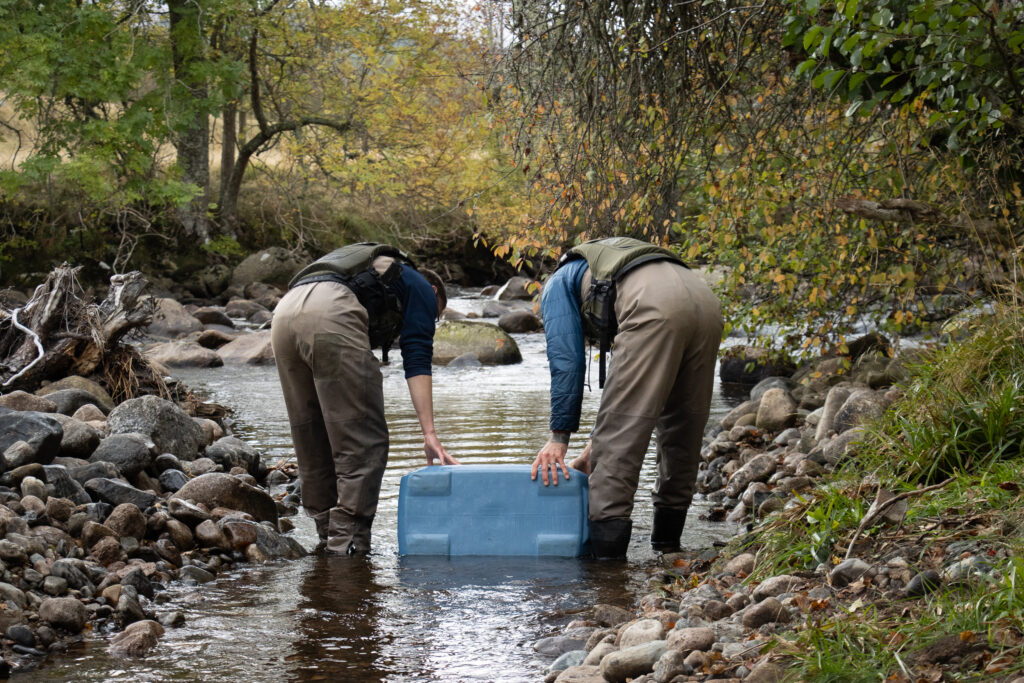
In early October, 91 adult salmon from Save the Spring‘s Smolt-to-Adult Supplementation (S2A) trial were returned to the River Muick at three release sites. Two sites were in the river’s lower reaches, while the third was above the Linn of Muick. Each fish was released in the area where it had originally been caught as a smolt.
These fish are the second annual cohort of adult releases under the Save the Spring pilot programme. Our focus is to understand how they behave after returning to their natal river. Because the sex ratio favours females, we hope this cohort will make a meaningful contribution to the river’s overall egg production.
To help answer this question, 61 fish—69% of the total release group—were fitted with acoustic radio tags before release. The tags allow us to track their movements throughout the catchment. Monitoring is carried out using a network of six fixed receivers, up from four last year, and is supplemented by regular walking surveys using handheld equipment.
Most of the fish released this year were one-sea-winter (1SW) salmon. They were captured as smolts in spring 2025 and spent one winter at the University of Stirling’s Marine Environment Research Laboratory (MERL).
Four individuals, originally captured as smolts in spring 2024, were retained for an additional year and returned as multi-sea-winter (MSW) fish, averaging approximately 4.5lb in weight. Interestingly, several 1SW fish surpassed the MSW fish in size, with the largest weighing around 7.5lb.
Encouragingly, the early signs following release have been very positive. Most fish have moved away from their release sites and progressed upstream, in some cases covering considerable distances.
One particularly enthusiastic male reached the Linn of Muick only two days after release, having travelled approximately 4.5 miles in that time. Several fish released at the two lower release sites are now holding immediately downstream of the falls, and we hope they will continue their upstream migration once river conditions and water levels allow them to pass through the fish pass.
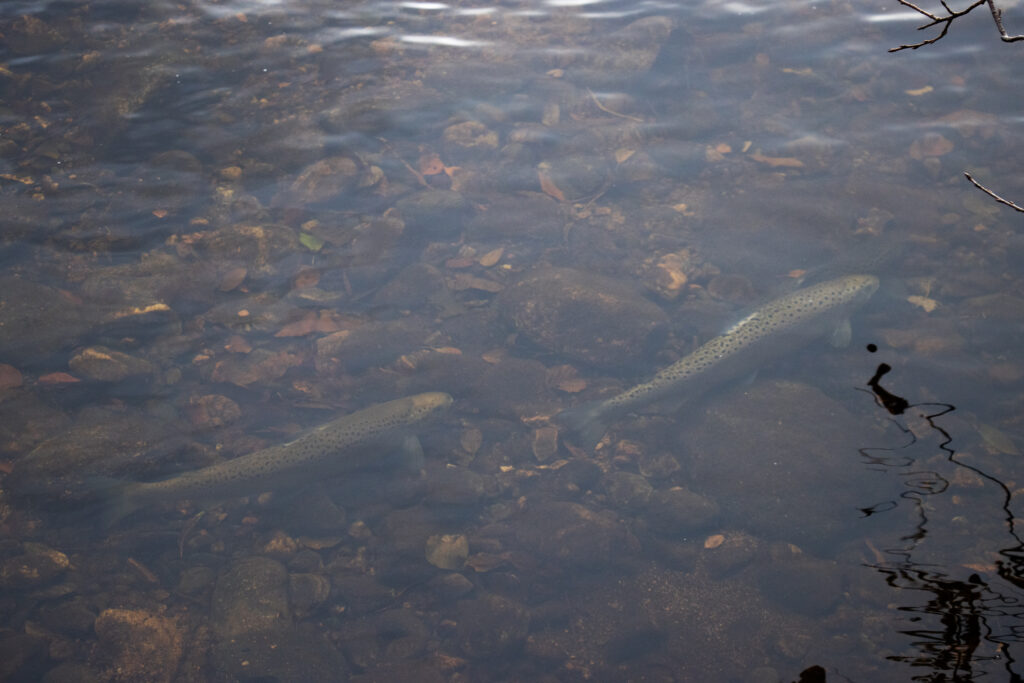
Perhaps most reassuringly, two tagged fish have been observed holding among a large group of fully wild salmon.
A Reminder: How the Trial Works
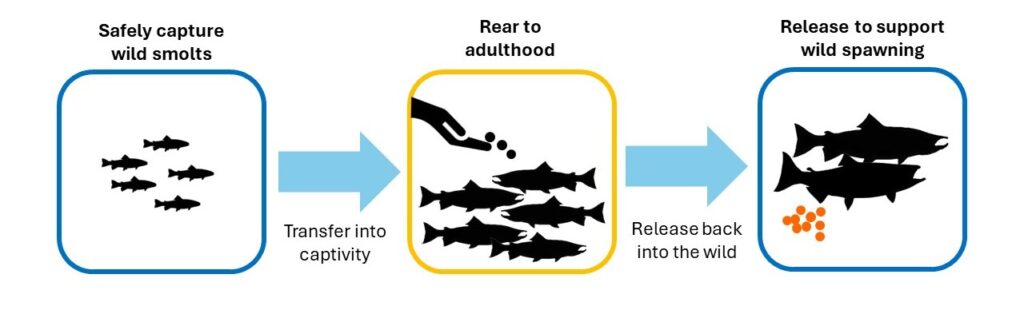
While only a snapshot, observations such as these suggest that the S2A fish are integrating naturally into the wild population and exhibiting behaviours consistent with those expected at this stage of the spawning season.
Visual observations have also been encouraging. A number of tagged fish have been sighted in the river during tracking surveys, and all have appeared healthy and vigorous. In addition, every radio-tagged fish has been detected by our monitoring equipment at least once since release.
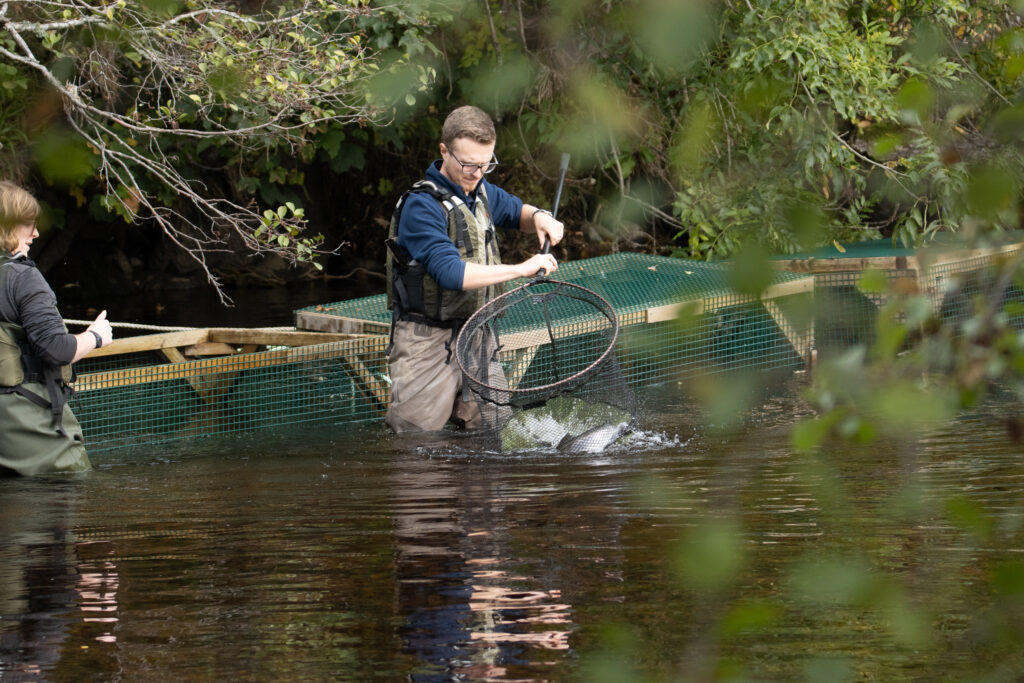
Prior to release, adult salmon were kept in holding pens in the river to allow them to acclimatise to temperature and flow.
Watching for signs of spawning behaviour
As the spawning season approaches, our attention is increasingly turning to the programme’s ultimate objective: determining whether these fish are contributing to the recovery of wild Atlantic salmon through successful natural spawning in the Muick.
Last year, we were unable to obtain direct evidence of spawning activity from the fish we monitored. However, future genetic surveys of juvenile salmon in the river will allow us to match offspring to their parents, helping to fill this important knowledge gap.
This year, with a larger release group and an expanded tracking programme, we will continue to monitor their movements closely in the hope of documenting S2A fish on the spawning grounds and gaining a clearer understanding of their contribution to the population.
Fish Returning to Recovering Habitat
Restoring natural processes and strengthening habitat resilience across the upper River Dee catchment are central to Save the Spring’s mission. As reported in our August 2026 Update, the completion of our detailed Catchment Audit will allow this work to accelerate at a strategic scale.
Fish from the trial have been released into areas where significant habitat-reconnection work has taken place. This demonstrates that the trial is not an isolated initiative, but part of a much broader programme of restoration.
The image below shows one of our fish-release sites on the River Muick, where a recently reconnected side channel joins the main river. We hope the trial will help the salmon population recolonise this habitat.
Working in Partnership
Our thanks to those who helped us reach this milestone
The Save the Spring partnership would like to extend our thanks to the team at the University of Stirling Marine Environment Research Laboratory for their ongoing support with our trial. In addition, generous private donations from individuals within the catchment have enabled this important pilot to continue.