Salmon & Sea Trout Recognition
Wild Salmon Crisis
The wild Atlantic salmon population in Great Britain is now endangered.
Salmon & Trout – What’s the difference?
Wild Atlantic salmon and their cousins, sea trout (sea-running brown trout), both have a fascinating and varied lifecycle, with many similarities but also some key differences. Both species are often encountered by anglers and other water users, and having the knowledge to distinguish between the two can be helpful.
How do you tell the difference between adult salmon and sea trout?
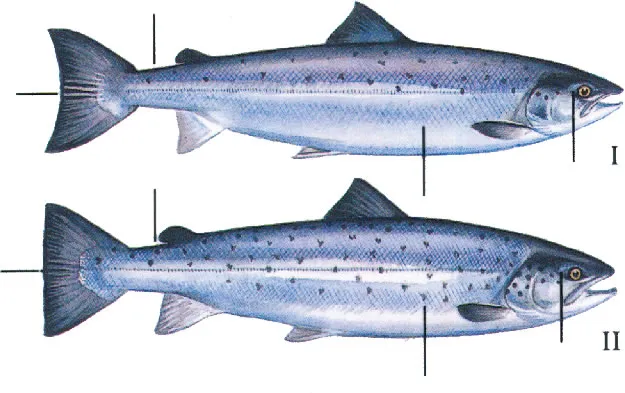
Adult salmon (I) can be distinguished from large adult sea trout (II) in a number of ways:
- A more streamlined shape.
- A concave (slightly forked) tail, whereas the sea trout’s tail is more square.
- A slimmer tail ‘wrist’ – the part of the body which connects the tail to the fish’s main body, known as the caudal peduncle.
- A salmon’s upper jaw reaches no further than rear of the eye.
- Salmon have few, if any, black spots below the lateral line.
- Salmon have 10-15 (usually 11-13) scales counted obliquely forward from the adipose fin to the lateral line, whereas trout have 13-16.
How do you tell the difference between juvenile salmon and sea trout?
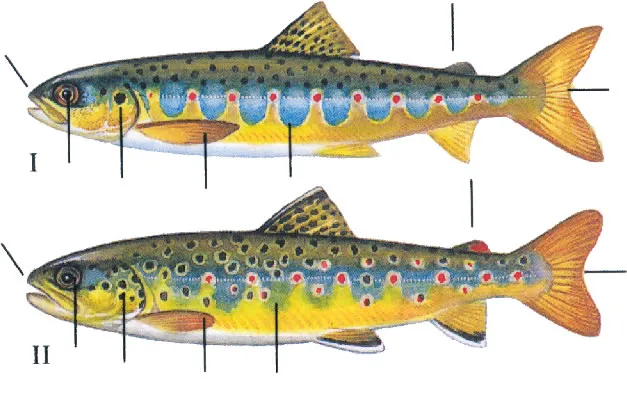
This image shows a juvenile salmon parr (I) and a small brown/sea trout (II).
Juvenile salmon parr can normally be distinguished from young trout by their more streamlined shape, deeply forked tail, longer pectoral fins, lack of orange on the adipose fin, a smaller mouth, sharper snout, and only 1-4 spots on the gill cover (often one large spot), plus well defined ‘parr marks’.
NATURE, PEOPLE, PLANET
Why Wild Salmon Matter
Wild Atlantic salmon are a keystone and indicator species – critical to the overall structure and functioning of their ecosystem. They report back to us about the health and condition of the places in which they live. However, their numbers have fallen by over 70% in the last few decades and the species is now endangered in Great Britain – a warning sign of much larger environmental problems facing our rivers, coasts and seas.
This iconic species is also deeply connected to communities across the North Atlantic. Our shared natural and cultural heritage has been interwoven with the species for centuries. That is now at risk.
The future of wild Atlantic salmon needn’t be one of continued decline and disappearance. Though the challenge to halt and reverse the decline is great, wild Atlantic salmon can have a thriving future if we choose to give it to them.